

Lake Pointe Dental Care
The Many Faces of Tooth Pain
 Many people think that a painful tooth means they need a root canal treatment. While that is sometimes true, it’s not always the case. In fact, there are many other reasons that teeth can hurt!
Here, we offer a guide to some common types of tooth pain and what that pain may be trying to tell you:
Sensitivity to hot and cold foods:
If the pain is short-lived, you probably do not have a serious problem, but more likely a loose filling or a small amount of gum recession that has resulted in root surface exposure. Use sensitive teeth toothpaste and a soft brush with an up and down motion. If this doesn’t help after a week or so, give us a call.
Heat sensitivity after an appointment:
Some types of dental work can inflame the pulp inside your teeth, causing sensitivity for several weeks. If it lasts longer than that, let us know.
Sharp pain when biting:
Sometimes sharp pain can be caused by a loose filling, other times it may signal that there is a crack in your tooth. Either of these scenarios requires evaluation by a professional, so please give us a call.
Pain/Sensitivity lasting longer than 30 seconds:
Often this means that the pulp (innermost part of your tooth) has been damaged. Without intervention, you may lose this tooth so it is important to call us to find out if you may need root canal treatment.
Frequent, dull aching in the jaw.
This can happen when excessive grinding of the teeth happens (bruxism), or it could even be a sign of a sinus headache or infection. Please call us for more information.
Severe pain, pressure or swelling of the gums:
This may mean that you have an abscessed, infected tooth that may have spread to other tissues in the mouth. This is a serious situation that requires an immediate call to our office for instructions.
Children’s Teeth Timeline
 Do you know when your child should be expecting their first new teeth as a baby? How about when they should be loosing those baby teeth? As with many things in development, every child is different and has a different time frame for each stage, but we’ll give you a general idea of when you can expect these different stages to occur: from the appearance of baby teeth to the arrival of permanent adult teeth.
BABY TEETH
4 to 7 months:
Usually the two front lower teeth begin to be exposed. Gums may become red and swollen where the teeth are cutting through.
Fun Fact: Lower teeth usually come in before the upper teeth.
8 to 12 months:
Upper middle teeth tend to come in next (it is common for girls to get their baby teeth before boys!)
9 to 16 months:
Teeth on both sides of the middle teeth begin to come in, for both the top and bottom.
Did You Know: Teeth usually erupt in pairs! One on the right, one on the left!
12 to 19 months:
Molars come in on the top and bottom about the same time.
16 to 23 months:
Canines (sharp, pointed teeth) begin to emerge.
Tooth Truths: Baby teeth are usually brighter and whiter than permanent teeth, and are much smaller.
2 to 3 years:
Second molars come in, and by now your child should almost completely have a full set of 20 teeth! By 4 years old, jaw and facial bones continue to grow to allow more space for the incoming permanent teeth.
–NOTE: If your baby does not show signs of bottom teeth by 18 months, mention it to your doctor. Do not be alarmed, every child is different and some don’t begin showing teeth until after their first birthday, and catch up without any problems.
LOOSING TEETH/ADULT TEETH
6 to 12 years:
Children begin loosing teeth, they can be lost in any order, but it is common to lose them in the same order they came in, starting with the front middle, gradually going back further in the mouth.
12 years:
Once your child has lost all of their baby teeth, their mouth now consists of 28 permanent teeth. Four wisdom teeth will begin to appear between 17 to 21 years old, however 85% of people end up having their wisdom teeth removed, so don’t get used to them for too long!
Invisible Braces- Not Just for Looks
When most of us think of invisible braces such as Invisalign®, we naturally assume that their sole purpose is to enhance the aesthetic value of one’s smile.

And to a certain extent that assumption is true. For most people with braces of any type, the primary goal of straightening their teeth is improving their look. But did you know that there are actually added health benefits to having a straighter smile as well?
Here, we outline just a few reasons, outside of the obvious aesthetic benefits, that invisible braces can help you:
- Periodontal Health: Overcrowded teeth can result in swollen, red, irritated gums. More often than not, these symptoms are the result of periodontal disease. Braces help to straighten and evenly space teeth to allow for enhanced gum health.
- Better Cleaning Access: Because the clear teeth aligners are removable, you can do a better job of brushing and flossing your teeth, just as you would without braces. By contrast, traditional metal braces limit access to the surfaces and in-between areas of teeth, making it difficult to maintain a good brushing and flossing routine.
- Healthy Diet: Invisible braces are removable, which means that there are no restrictions to what you eat. This allows you to continue your healthy eating habits just as if you didn’t have braces at all. With traditional metal wires and braces, however, some people fall into the trap of eating only soft foods and thus miss out on much-needed nutrients.
- Overall Health: Because oral infections are thought to be related to other health issues in the body such as an increased risk of heart disease, stroke and diabetes, keeping your teeth properly spaced and straightened is an important first step toward better health throughout your body.
Allow us to enhance your smile both aesthetically and from an oral health standpoint as well with invisible braces!
Dental Implants vs Dentures and Bridges
Whether it was during a consultation in our office or perhaps while you were doing your own research online, you have probably come across the term “dental implant” at some point. A dental implant is a great way, often the best way, to replace a missing tooth.
So how do you decide if a dental implant is the right path for you, or if a more traditional tooth replacement method such as dentures or bridges is the best way to go?

We have been asked this question many times, and have compiled a comprehensive breakdown of the benefits that implants offer over their conventional counterparts. We hope that this guide will help make the decision process easier for you.
Dental Implants vs. Dentures and Bridges: Things to Consider
- Longevity: Dental implants offer a long-term solution (often lasting a lifetime) to missing teeth, while dentures and bridges require replacement every 5 to 10 years. Not only does this mean less hassle, it also means that implants may be more affordable over time.
- Quality of Life:
- Simply put, dental implants look, feel and function more like natural teeth than do dentures and bridges.
- With a dental implant, our patients can hardly notice the difference when biting into hard objects. They also look more natural.
- In addition to that, dental implants are fixed – they are not going to fall out while you are talking or smiling, and you don’t have to put them away each night when you go to sleep. They remain in your mouth, anchored to your jawbone at all times.
- Bone Stability and Health: Just like muscles, bones also need a “workout” in order to maintain their mass and health. So when a tooth is missing from the jawline, the bone underneath the old tooth site becomes atrophied and shrinks. Dentures and bridges do nothing to help this deterioration. However, dental implants actually screw into the bone and integrate with it, actually encouraging new bone growth.
- Overall Health: Because implants allow for a normal range of food choices in the diet (a benefit not afforded by dentures), they encourage you to continue your healthy lifestyle for the rest of your life!
Do you still have questions? As always, we are here to answer any questions you have. Give us a call for more information!
Teeth Whitening- At Home vs In-Office Treatments
Over the last decade, at-home tooth whitening systems have become more abundant, more varied, and more affordable. A quick walk through your local drug store is all you need to do to know that there is an endless supply of teeth bleaching treatments that you can do at home to achieve a whiter smile.

You may be wondering, “If it’s so easy to access these products in a store, why would I want to spend the time and money to have my teeth whitened in my dentist’s office?”
Here are the top five reasons that we recommend that you come see us first if you are interested in whitening your smile:
- Whiter whitening: Over the counter bleaching products can only contain 10% peroxide, while our in-office treatments can contain 25-40% peroxide, offering a whiter white!
- Quicker: The higher concentration of peroxide combined with other safety and acceleration tools like lasers allow us to whiten your teeth much more quickly than can be done at home.
- Fewer Side Effects: At home, some people experience damage to the tooth or surrounding gum area when whitening their teeth, causing pain or sensitivity. By contrast, in the office, we have access to preventative tools that can protect your gums and teeth from damage from bleaching.
- Always Examine First! It is always wise to have an oral exam prior to your whitening procedure, as we can detect potential problems, areas that are prone to sensitivity, and even help you choose your best path to a whiter smile.
- Best of Both Worlds: If you still want to try at-home treatments, give us a call. We can send you home with approved whitening treatments to give you the protection, convenience and the whiter smile that you desire.
Teeth in the News- Dental Care Reduces Respiratory Infections in the ICU
We are always pleased to pass along any oral health information to our patients and their families as we come across it in our various news sources. Simply put: we love it when we find teeth in the news!

While we don’t spend significant time in hospitals ourselves, we were still happy to hear about a recent study that suggests that patients in the intensive care unit (ICU) of a hospital benefit from enhanced dental care in more ways than you would expect!
Typically, in an ICU setting, patients receive routine oral hygiene treatments from the nurse staff. However, when researchers assigned half of the patients to receive enhanced dental care from a dentist that included brushing, tongue scraping, calculus removal and more, they found that those patients were 56% less likely to develop a respiratory tract infection during their ICU stay.
This is significant because hospital-acquired infections such as respiratory infections are not uncommon due to the nature of the hospital environment and can be dangerous for vulnerable patients. You may be wondering “What is the connection between oral hygiene and respiratory infections?” In fact, infections such as these often originate in the oral cavity. Catching them early before they get into the major organs of the body may be one way to combat healthcare-associated infections.
This is just another example of how your oral health affects the health of your whole body! Be sure to employ excellent brushing and flossing habits at home while you are well to avoid additional problems in your body down the road!
Dental Implants- A Three-Step Procedure
One of the most common questions we hear from patients when it comes to dental implants is “Why does it take three separate procedures?”
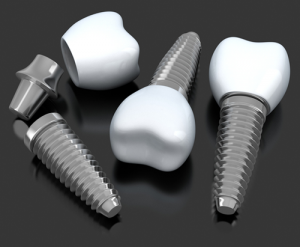
It helps to understand that within the entire dental implant process, there are not just three stages, there are also three important parts to the final product that replaces your tooth. First, there is the implant itself, which is the metal rod that we surgically implant into the bone. Next, there is the abutment, which connects the implant to the artificial tooth. And lastly, the crown (or prosthetic tooth) itself.
The fact that the process has three physical components alone doesn’t tell the whole story though. Here, we explain why the most commonly employed dental implant method is split up into three separate procedures.
Step One: Placing the Implant
The first stage of the dental implant process is to bury the implant in the jaw bone via a surgical procedure. The dental implant replaces the tooth root, and requires healing time. During this healing time, osseointegration (the integration of the bone with the implant itself) occurs. The bone cells actually attach to the implant rod, filling in the spaces to secure the implant in place for permanent residency. The healing time usually takes from 3-6 months.
Step Two: Placing the Abutment
The abutment is a post that connects the implant to the prosthetic tooth. Essentially, the abutment is a bridge that spans through the gum line so that the implant itself remains buried. As with the implant, the abutment has a healing period of its own. The gum around the abutment must heal and form a cuff or collar around it before the crown can be placed.
Step Three: The Prosthetic Tooth
Once the implant site and abutment have successfully integrated, the prosthetic tooth is fabricated and installed.
If you have any questions about the dental implant process, give us a call!
Porcelain Veneers for a Flawless Smile
Some patients come to us loving their smile but wanting just a little bit more in terms of aesthetics. To perfect an already great smile, we may suggest porcelain veneers. Porcelain veneers are often our go-to tool to correct minor imperfections on the surface of teeth or spacing issues.

Here are some frequently asked questions and answers about veneers:
Q: Are veneers heavy or thick? Will I feel them in my mouth?
A: No, in fact veneers are thinner than a fingernail, once they are in place you won’t even know they are there!
Q: How long do they last?
A: Properly installed, veneers can last from 10-20 years. A great investment for an enhanced smile!
Q: How are they attached? Can they fall off?
A: Veneers are attached to your tooth with a very strong bonding compound. They do not fall off and provide years of durable use.
Q: Do veneers look like natural teeth?
A: Porcelain is the perfect material to copy tooth enamel, as it is incorporates luster, shine and translucence to look just like your natural teeth.
Q: What if the surrounding teeth are a different color?
A: Generally what we recommend is that we use a whiter shade of porcelain for the veneer and perform tooth whitening in conjunction with the veneer process to give you a perfect match throughout your mouth.
Q: Do veneers stain?
A: No, porcelain veneers do not stain, even over time.
If you want to take your smile from “okay” to “stunning”, ask us if veneers are a good option for you!
Straight Teeth Without the Brackets and Wires: Invisalign®
Nothing compares to the look a child gives us when he or she is told they need braces. The fact of the matter is that many kids and young adults do eventually need some sort of treatment to fix gaps and cracks in their smile. But unfortunately, the combination of metal wires and crooked teeth can cause social embarrassment for many adolescents.
What if there was a solution that not only straightened your teeth but also avoided the hassles of traditional orthodontic braces?
As you may have guessed, there is a solution: a revolutionary treatment appropriately named Invisalign®. Unlike regular metal wire braces, Invisalign® uses clear, removable trays, molded to the shape of your teeth to straighten your smile over time. Invisalign® is a great solution for adults and many adolescents as well.
How do we use Invisalign®?
First we will take an x-ray and impression of your teeth, which will then be sent out for the creation of a 3-D model of your teeth. A series of custom plastic aligners are then created out of liquid resin, hardening in a plastic mold.
How should you take care of your aligners?
In order for the Invisalign® process to be effective, you will need to wear each set of aligners for two to three weeks. In total, the process takes approximately 13 to 14 months. Aligners should only be removed for brushing, flossing and eating. When the treatment process ends, you will be encouraged to wear a retainer at night to maintain your new smile!
What other benefits does Invisalign® have over traditional braces?
While the main appeal of Invisalign treatment is its transparent appearance, it also avoids some of the health disadvantages that are associated with traditional braces, such as the shortening of tooth roots, increased chance of tooth decay and interference with x-rays.
Are you looking for an improved smile? Call us to schedule your Invisalign® consultation!
Dental Implants: Are They Right for You?
Not everyone is blessed with perfect teeth. Many people would tell you they lack the smile they’ve always wanted due to genetics, disease, and sometimes even accidents. Fortunately, we have a solution. With dental implants, you will no longer feel self-conscious about your smile; but rather delight in having a new and improved grin!
 What are dental implants?
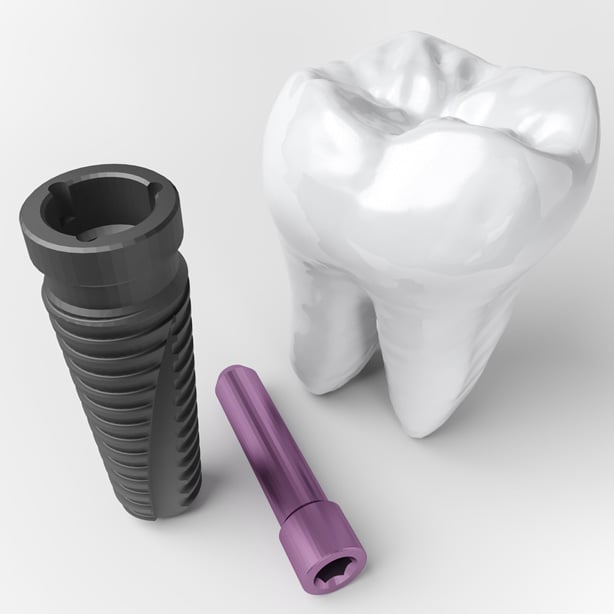
Technically, dental implants are replacement roots for missing teeth. First, the implant, a titanium screw, is inserted into the jawbone. Next, a removable or permanent replacement tooth is attached to the top of the implant to mirror the appearance of your natural teeth. Currently, over 3 million people worldwide have dental implants and the technology has reached a point where each procedure has a 98% success rate.
Why should I get dental implants?
Beyond simply improving the appearance of your smile, dental implants include many other benefits:
- Oral health: Unlike other restorative procedures, dental implants do not necessitate the reduction or alteration of neighboring teeth, thus resulting in improved oral health overall. Additionally, dental implants do not interfere with access to neighboring teeth, so it is no harder to brush or floss.
- Longevity: While other dental aides such as dentures and bridges inevitably require replacement, dental implants are extremely durable, lasting many more years and in some cases even a lifetime!
- Convenience: Dental implants do not ever need to be removed for activities such as eating, drinking and brushing, and do not require adhesives. They act, look and feel just like natural teeth!
How much do dental implants cost?
Dental insurance does not always cover the cost of dental implants. However, in the long run, dental implants are usually cheaper than other restorative procedures. Because they do not need to be replaced, the initial investment for implants is well worth the price.
Dental implants are becoming a popular trend in the world! Call us to set up an appointment to upgrade your smile!